
In the place where they gathered


Cote d’Azur means blue coast, better known as the French Riviera, which has drawn celebrities and artists for centuries. During the 20th century many of the artistic luminaries flocked here for the weather, the atmosphere, and each other. The Fondation Maeght is the best starting place to experience this phenomenon. It is one of the finest collections of modern art in the world and I expected a much larger facility. Their collection is large though they only exhibit a small choice grouping of works both inside and outside. The Maeghts were art publishers so the collection includes many volumes one if which was an Andy Warhol cookbook that included a recipe for fighting fish gefilte fish.
Miro’s work features most prominently and the building itself looks a little like a Miro sculpture. There is a labyrinth outdoors constructed around Miro’s free standing works, arches, and water courses. It looks like he had a lot of fun with this. He created this in the 1960s and it’s probably the only permanent installation.
My two favorite paintings inside were these large paintings by Chagall on the left (La Vie/The Life, 1964) and Bonnard on the right (L’Ete/Summer, 1917). Both uplifting and full of bright colors, a hallmark of everything we will see on the Côte d’Azur.
Giacometti’s dog is one of my favorites though I have never seen the cat before. Ellsworth Kelly, the American artist, lived in Paris but not on the Côte d’Azur. He did have a lifelong relationship with Aime and Marguerite Maeght and has had numerous exhibitions here. This major exhibit is titled “At the Edge of Water” and the blue floor piece exemplifies the theme and the place. Kelly spent a lot of time living and working near bodies of water and said of his work, “In my paintings, I do not invent; my ideas come from a constant investigation of the appearance of things.”

Not far from the Fondation Maeght is the Matisse Chapel in Vence. Matisse first came to the Côte d’Azur in 1916 and designed this chapel from the architecture to everything contained within in, including vestments from 1947-1951 as a thank you to the nuns who had nursed him through a difficult illness, and one particular nun who remained with him for the rest of his life.
There was controversy surrounding the relationship between Matisse and his nurse who was a nun but had been his model earlier in life. A scandal at the time but the resulting work of art is breathtaking. It is interesting that Matisse was a lifelong aetheist, yet the wall mosaic is a very large depiction of the stations of the cross.
There’s no mistaking the Fernand Leger Museum in Biot. It is the only museum entirely dedicated to the artist’s work. It contains many monumental paintings, ceramics, and mosaics. Leger came to this location as there was already a thriving ceramics industry and he wanted to expand his work in this media. He died shortly thereafter and his family established the museum. Many works were inspired by his time during WW2 when he sought refuge in the United States. He explained his inspiration from being in big cities, especially New York.
Two dance archaeologists, Millicent Hudson and Kenneth Archer reconstructed a ballet entitled “Creation of the World” for which Leger made the costumes and sets. The composer Darius Milhaud wrote the music in 1923 and it was performed in 2000.

The museum is exhibiting Leger’s largest work “Le Transport des Forces” from 1937 commissioned for the international exposition of arts and technique. Originally 10 m long (33 ft) it was cut down some to 8 m. It moved around quite a bit and was not well cared for until 2020 when the Leger Museum repaired and secured it for display. The painting celebrated electrical energy, industry, and nature through a cosmic allegory combining machinery, a waterfall, and rainbow. It is the largest work Leger ever created.

The Chateau Grimaldi is home to the Picasso Museum in Antibes. Picasso spent a good portion of his life as an artist in Provence, Inspired by the light and colorful landscape. He arrived in Antibes in 1946 with his wife Francois Gilot. He was given a studio in the chateau for one year where you can see the work that fills almost the entire building. Eventually the building became a dedicated Picasso museum with later works added from his estate. The collection shows the versatility of Picasso who worked in so many different media and so many different styles. Since this was work done in the year following World War II one is struck with the calmness and joy in contrast to his work during the war years that was dark and hostile. The Minotaur is replaced with a goat and satyrs.
One can imagine Picasso, Francois, and their two children Claude and Paloma here. Antibes was once a much sleepier place now overrun, even in September with tourists.

A large painting in the collection “La Joie de Vivre” painted in 1946 uses some of Picasso’s favorite mythological themes. He is the centaur playing the flute, with Francois, the Maenad (female follower of Dionysus) who is dancing while two fauns (probably their children) jump about and a satyr plays a panpipe. It reflects the bright colors that most of the artists were using and feels quite joyful.
Two more paintings from this period, “Vase with Foliage and Sea Urchins” and “The Goat” both done at the chateau in 1946. It was a very productive period for Picasso and reflected themes he would come back to many times. In 1950 Picasso made his famous goat sculpture using a wikcer basket as the ribcage.

“Ulysses and the Sirens” from 1947 was commissioned by the Grimaldi Museum and was completed in three days after Picasso completed his residency there. He painted it on the floor using no traditional painting media, industrial fibrocement panels and Ripolin paint. Ulysses is lashed to the mast of his boat, his face transfixed and tragic as he stares forward under the spell of the siren song. The sea creatures and sirens merge into fragmented dangerous shapes. It’s a big contrast to everything else in the museum.

Pierre Bonnard was a friend, mentor, and colleague to many artists on the Côte d’Azur. He was a founding member of the post-impressionist group known as Les Nabis. They moved to symbolism and were very influenced by the work of Paul Gauguin and Paul Cezanne. Bonnard painted landscapes and mostly intimate domestic interiors full of color and pattern.

“The Tub”, 1909 is an oil painting of Bonnard’s wife Marthe in an intimate setting seen through a mirror that frames the scene in a very unusual way. It’s a strange vantage point that brings our focus to various objects in reflection.

“Studio with Mimosa” painted 1939-46 is a view out his studio window in Le Cannett (where the museum is located) and shows his vibrant use of yellow. You will recall earlier in this blog post I shared one of Bonnard’s landscapes at the Maeght. This one is more intimate but no less bold and colorful. An almost hidden face of Marthe appears in the lower left corner and there is a hidden face in the top of the mimosa tree.
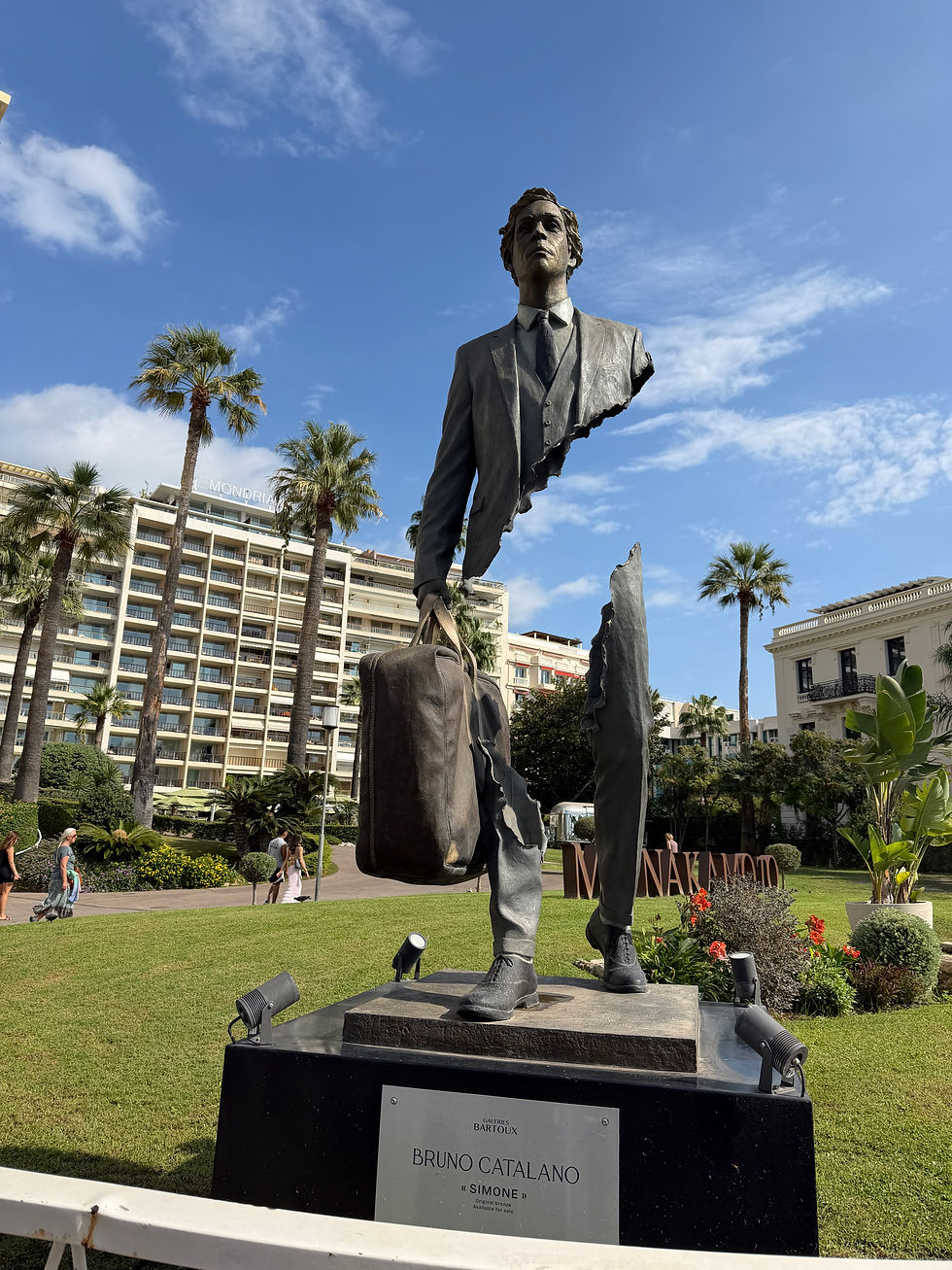
Except for the art we’ve seen this sculpture represents what much of the “Riviera” seems to be; lots of expensive shopping and unnecessary excess. The sculptor is Bruno Catalano and it’s located in front of the hotel where the Cannes Film Festival is staged.


Comments