
Honoring the masters

France has national museums to celebrate the work of individual artists. Three of them are located in or near Nice. From left to right the Matisse Museum, Chagall Museum, and Picasso Museum. All are located in places these artists lived for part of their artistic careers.
Starting with Matisse if you are in the Art Appreciation course you might recognize the “Swimming Pool.” If this is not familiar to you Matisse moved to Nice in the 1920s which coincided with a shift in seaside activity. Swimming pools became very popular and Matisse created this paper pool, “La Piscine”, 1952 a space of freedom that allowed him to escape what had become a physical impairment at least in his imagination he was in the pool. It has recently been restored as some of the paper had faded and is now installed in the museum.

The remainder of the museum was an exhibition of the relationship between Yves Saint Laurent and Henri Matisse. Yves Saint Laurent was 18 years old when Henri Matisse died though his influence was profound on the designer.
Matisse used clothing as a principle means of organizing his pictorial compositions. The painting (sorry for the lettering across as I could not get a better image) from 1941 includes outfits of haute couture and Matisse himself chose the materials and patterns to be made so he could use them in his work. The two dresses of Yves Saint Laurent you see have patterns he used frequently and these were featured in his 1994 collection.
In “Blue Dress Reflected in a Mirror” from 1937 is modeled by Lydia Delectorskaya, Matisse’s model of choice at the time and it is a dress she made herself from fabric chosen by Matisse. The dress becomes the focal point as the figure almost recedes into the background. The Yves Saint Laurent dress is from 1981 is made from the same exact materials as the one in the painting.
A chasuble mock up for the Vence Chapel and an evening gown from Yves Saint Laurent
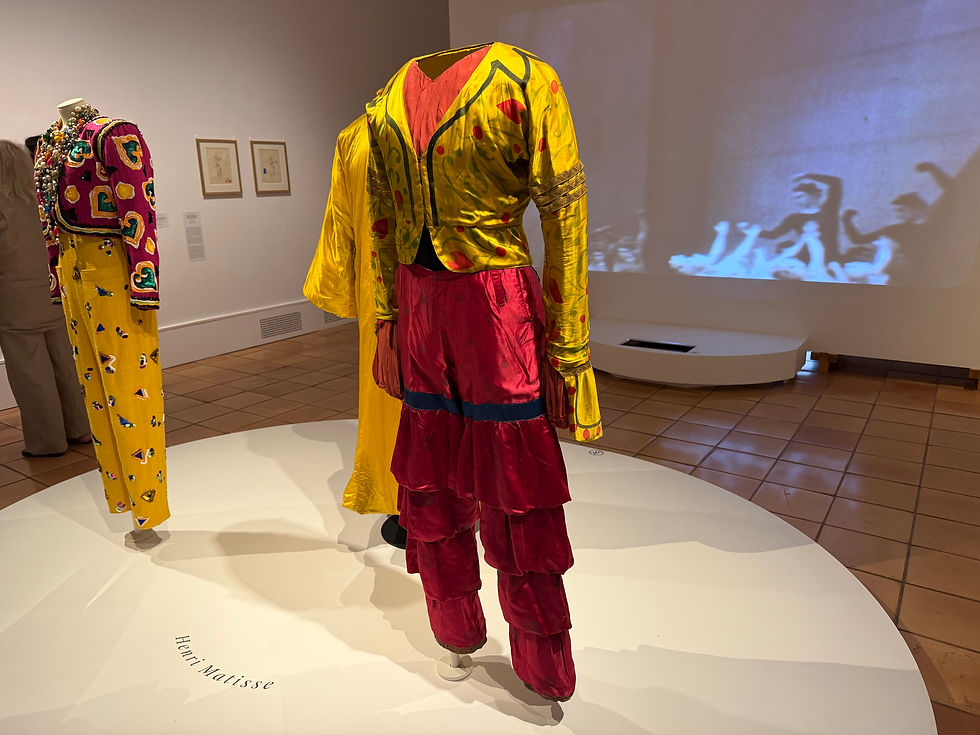
Another artist creating costumes for ballet, Matisse was invited by Serge Diaghilev to design the costumes for the Ballet Russes, “The Song of the Nightingale”. It was Matisse’s first movement away from painting and into decorative arts. Yves Saint Laurent followed his muse designing costumes for “Cyrano de Bergerac” in 1959 and continued designing for shows, especially when there was an orientalist theme.
Matisse discovered Islamic art during his travels in North Africa and Spain. Yves Saint Laurent made a profound connection with Morroco especially where he has a museum and spectacular garden in Marrakesh. Many of his collections include turbans and both he and Matisse collected costumes from the region.

The Chagall Museum in Nice was established in 1973 during the artist’s lifetime when he donated 17 massive paintings illustrating biblically scenes. This very large mosaic on an outer wall depicts the prophet Elijah ascending in a chariot, designed by Chagall and executed by master mosaicist Lino Milano.
Three examples of the large biblically themed paintings from left to right; Moses striking the rock to get water, Jacob’s Dream with angels going up and down the ladder, and Moses receiving the 10 commandments. The color in the first painting is quite different from most of the others though strategic amounts of light appear symbolizing a divine presence. In most of the paintings, Moses is depicted with rays of light emanating from his head, often interpreted in Christian texts and art as Moses having horns. The Hebrew word for horns and rays of light have the same root. Michelangelo’s famous sculpture of Moses shows him with horns. If you look closely at the one on the right you can see the Golden Calf in the background.

Chagall is known for stained glass windows and this set represents the seven days of creation. The first four days on the right (separating light and darkness, dividing the waters above and below, dry land, trees and plants, sun, moon, and stars) and the last three days (animals, humans, and the day of rest) on the left.
Picasso moved to Vallauris, a town south of Nice, known for its unusual clay and ceramic manufacturing. He set up shop in what is now the National Picasso Museum and had been a 12th century Romanesque chapel. Picasso became a fixture in the community and was quite beloved there. He not only brought fame to the ceramic industry but introduced an annual bull fighting festival since he missed his homeland of Spain so much. His work in ceramic was as varied as his painting styles. Left to right: “Tripod” 1951, “Bouquet in Vase” 1956, and “Persons and Heads” 1954.
I’ve not been a big fan of Picasso’s ceramic work though what I found in the museum was unique and quite enchanting. Left to right: Bird plate 1953, Fish plates both from 1952.

The main focus of the museum is the chapel Picasso created entitled “War and Peace” painted in 1952 in oil paint on panels mounted on the walls, so not technically frescoes. They are in pretty good condition probably because the chapel itself gets very little natural light. This is a secular temple dedicated to human pacifism. The murals span 125 square meters with two facing murals, one depicting war and the other peace.

Picasso wanted the space dim so a visitor would experience the imagery like prehistoric cave paintings. Following “Guernica” in 1937 this served as his ultimate statement against armed conflict. This side depicts war.

This side depicts peace. It is a yearning for peace as it was done during the Korean War so still not a peaceful time. We are still yearning.

Just outside the chapel is a rotating invitational space for artists working in a similar theme. The current exhibit is by Pascal Mathieu Tayou and this work is titled “Survival Tree”, 2018. The tree is centered on the earth adorned with glass masks and multicolored eggs. It features antler horns for branches and is rootless. It is meant to remind us of the palaver tree where people could sit and talk to each other in dialogue.
Three other examples of Tayou’s work in the entry hall to the chapel.


Comments